
Vol. 4 No. 2 (2025): May – August
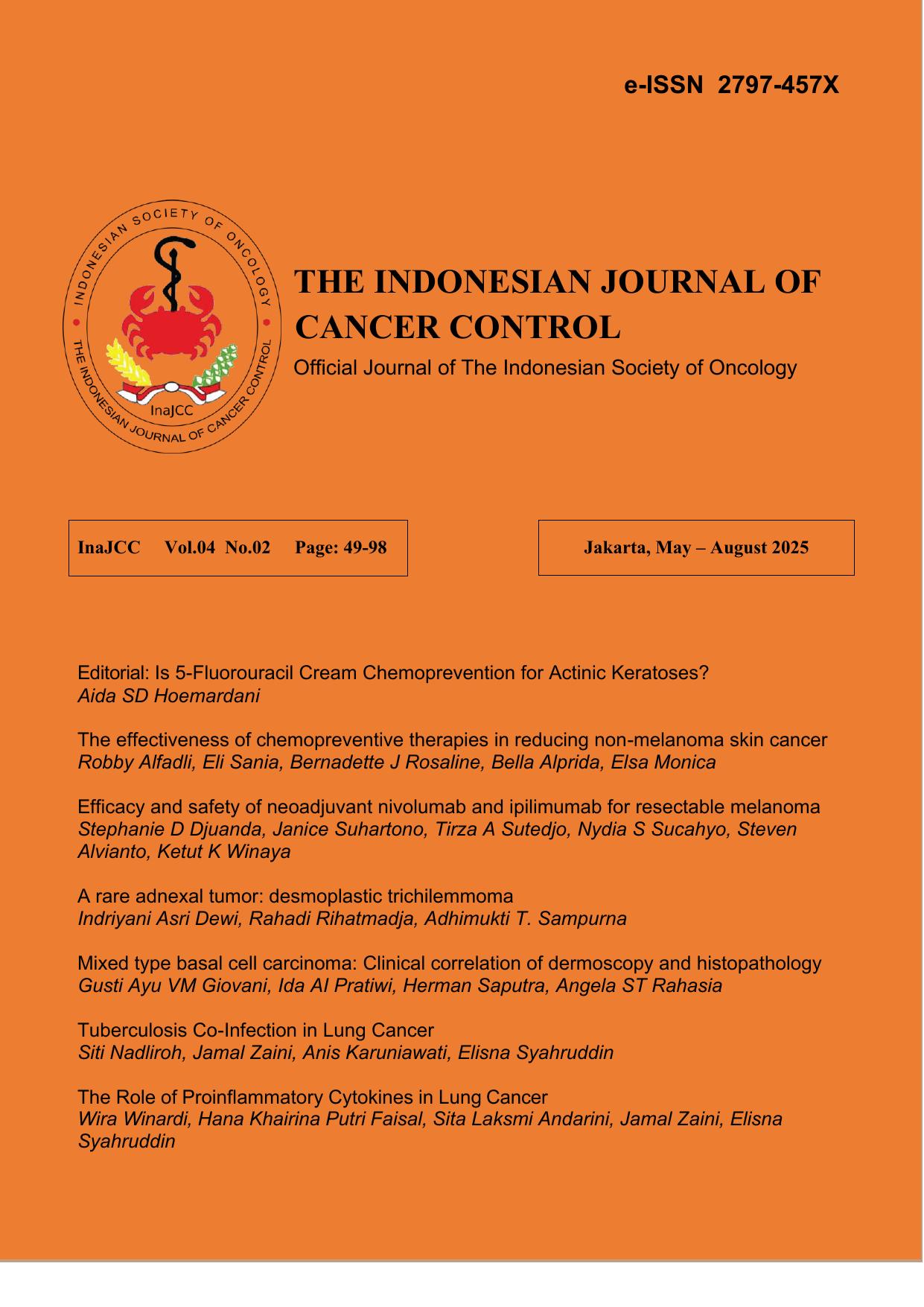
Volume 4 Number 2 follows cancer control from the first clinical decision through to the biology that decides the outcome. The editorial opens with a prevention question that is entirely practical: whether topical 5-fluorouracil is ready to be used as chemoprevention for actinic keratosis, the intraepidermal lesion that precedes squamous cell carcinoma.
Two original articles test what the evidence actually supports. A systematic review of chemopreventive agents in non-melanoma skin cancer finds NSAIDs, difluoromethylornithine, vitamin D3, nicotinamide and acitretin each reducing incidence, but at different points in the disease. A second review of neoadjuvant nivolumab plus ipilimumab in resectable melanoma reports relapse-free survival of 70 to 96 per cent across seven studies and 530 patients, with low-dose ipilimumab combined with high-dose nivolumab giving the best balance against grade 3 or higher toxicity.
Two case reports keep the focus on diagnosis. A desmoplastic trichilemmoma on the eyelid of a 66-year-old man is a benign adnexal tumour whose histology mimics invasive carcinoma; CD34 positivity with BerEP4 negativity settled the diagnosis and spared the patient unnecessarily aggressive surgery. A mixed-type basal cell carcinoma on the forehead shows why dermoscopy and histopathology must be read together when the subtype carries a higher recurrence risk and demands complete excision.
Two reviews close the issue on lung cancer. Tuberculosis co-infection, present in roughly 2 per cent of lung cancer patients, delays diagnosis because the two diseases present alike, and a history of tuberculosis raises lung cancer risk 1.7 to 2 fold. The final review traces interleukin-1, interleukin-6 and tumour necrosis factor alpha through the chronic inflammatory processes that support tumour growth, immune evasion and metastatic spread.