Archives
-
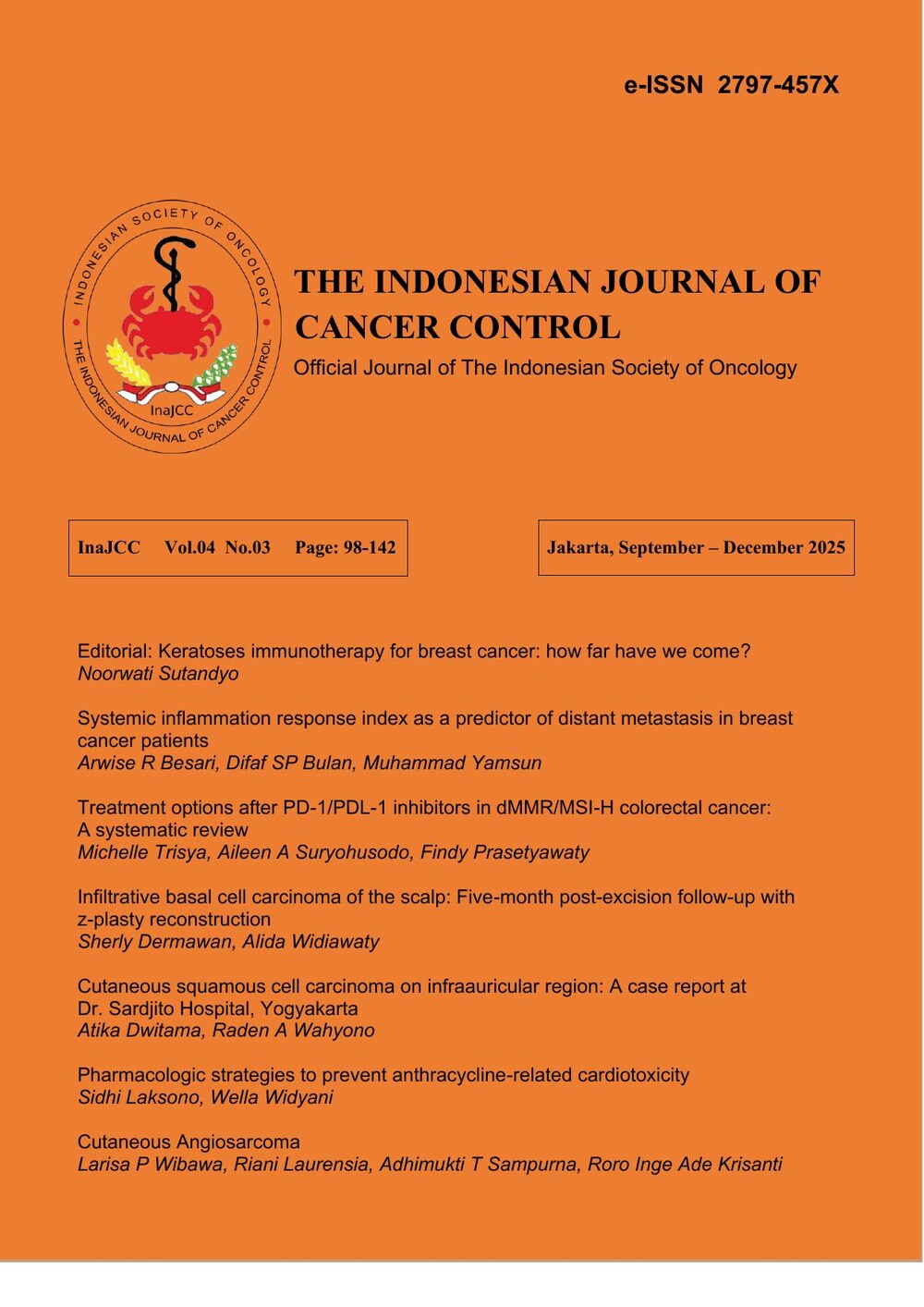
September – December
Vol. 4 No. 3 (2025)Volume 4 Number 3 moves from the systemic signals that predict how a cancer will behave to the decisions that follow them. The editorial asks how far immunotherapy for breast cancer has actually come, tracing the path from metastatic triple-negative disease to the adjuvant and neoadjuvant trials now under way.
Two original articles test what routine data can tell clinicians. A retrospective study of 869 breast cancer patients finds the pre-treatment systemic inflammation response index markedly higher in those with distant metastasis, pointing to a low-cost and non-invasive prognostic marker. A systematic review of MSI-H/dMMR colorectal cancer gathers nine studies and 38 patients who progressed on PD-1/PD-L1 blockade, and finds conventional chemotherapy of modest benefit while combinations with bevacizumab or CTLA-4 blockade produced responses lasting 12 to 36 months.
Two case reports return to the skin. An infiltrative basal cell carcinoma on the scalp of a 48-year-old man, in a site rarely exposed to sun but subject to chronic trauma, shows how subclinical extension defeats an apparently complete excision. A cutaneous squamous cell carcinoma below the ear of a 39-year-old woman illustrates why nodal and distant involvement must be settled before wide excision in the head and neck.
Two reviews close the issue. The first sets out the pharmacologic strategies now available to prevent anthracycline-related cardiotoxicity, a growing concern as survival after cancer treatment lengthens. The second covers cutaneous angiosarcoma, an aggressive malignancy of vascular endothelial cells that accounts for only one to two per cent of soft tissue sarcomas yet carries a poor prognosis.
-
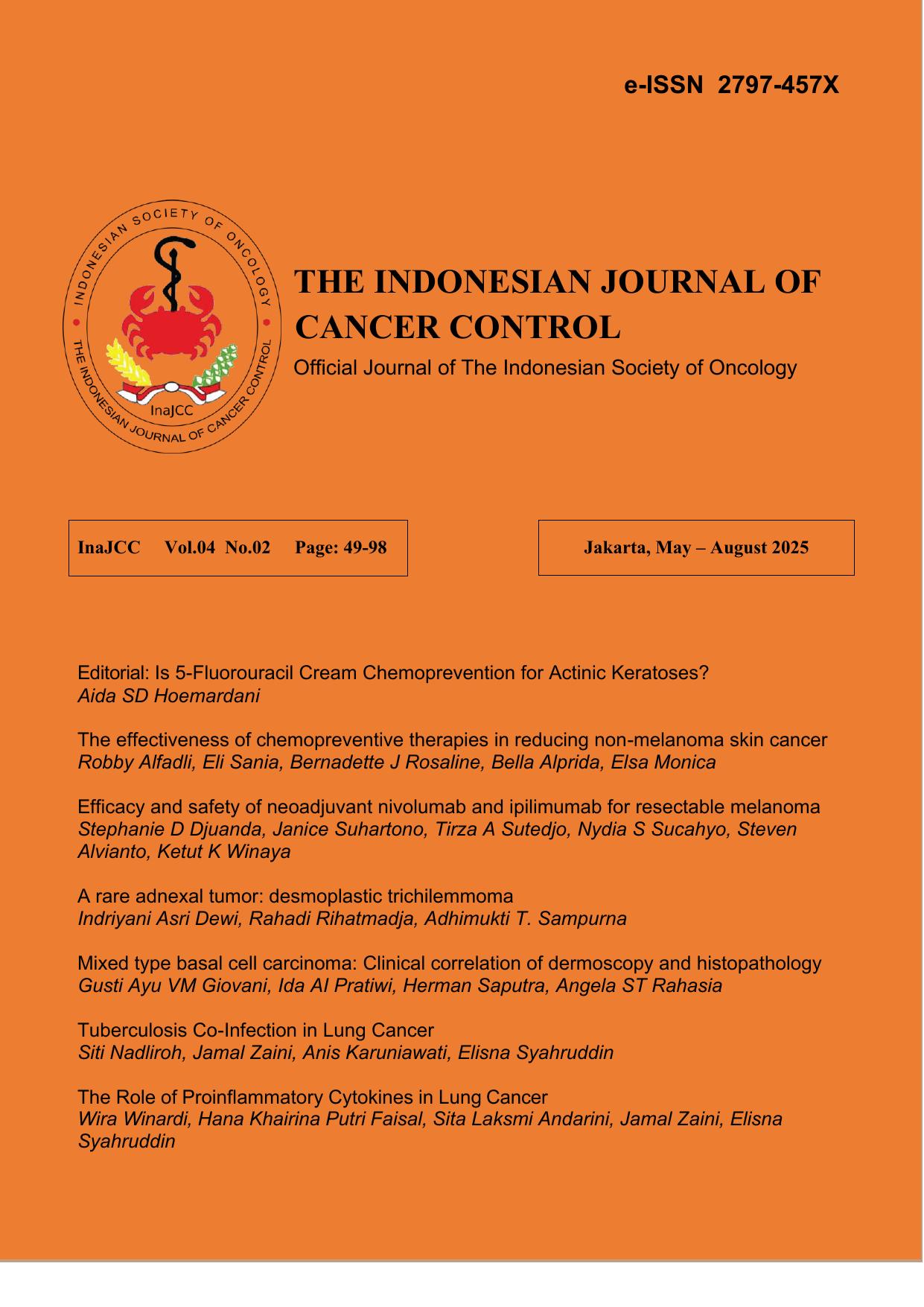
May – August
Vol. 4 No. 2 (2025)Volume 4 Number 2 follows cancer control from the first clinical decision through to the biology that decides the outcome. The editorial opens with a prevention question that is entirely practical: whether topical 5-fluorouracil is ready to be used as chemoprevention for actinic keratosis, the intraepidermal lesion that precedes squamous cell carcinoma.
Two original articles test what the evidence actually supports. A systematic review of chemopreventive agents in non-melanoma skin cancer finds NSAIDs, difluoromethylornithine, vitamin D3, nicotinamide and acitretin each reducing incidence, but at different points in the disease. A second review of neoadjuvant nivolumab plus ipilimumab in resectable melanoma reports relapse-free survival of 70 to 96 per cent across seven studies and 530 patients, with low-dose ipilimumab combined with high-dose nivolumab giving the best balance against grade 3 or higher toxicity.
Two case reports keep the focus on diagnosis. A desmoplastic trichilemmoma on the eyelid of a 66-year-old man is a benign adnexal tumour whose histology mimics invasive carcinoma; CD34 positivity with BerEP4 negativity settled the diagnosis and spared the patient unnecessarily aggressive surgery. A mixed-type basal cell carcinoma on the forehead shows why dermoscopy and histopathology must be read together when the subtype carries a higher recurrence risk and demands complete excision.
Two reviews close the issue on lung cancer. Tuberculosis co-infection, present in roughly 2 per cent of lung cancer patients, delays diagnosis because the two diseases present alike, and a history of tuberculosis raises lung cancer risk 1.7 to 2 fold. The final review traces interleukin-1, interleukin-6 and tumour necrosis factor alpha through the chronic inflammatory processes that support tumour growth, immune evasion and metastatic spread.
-
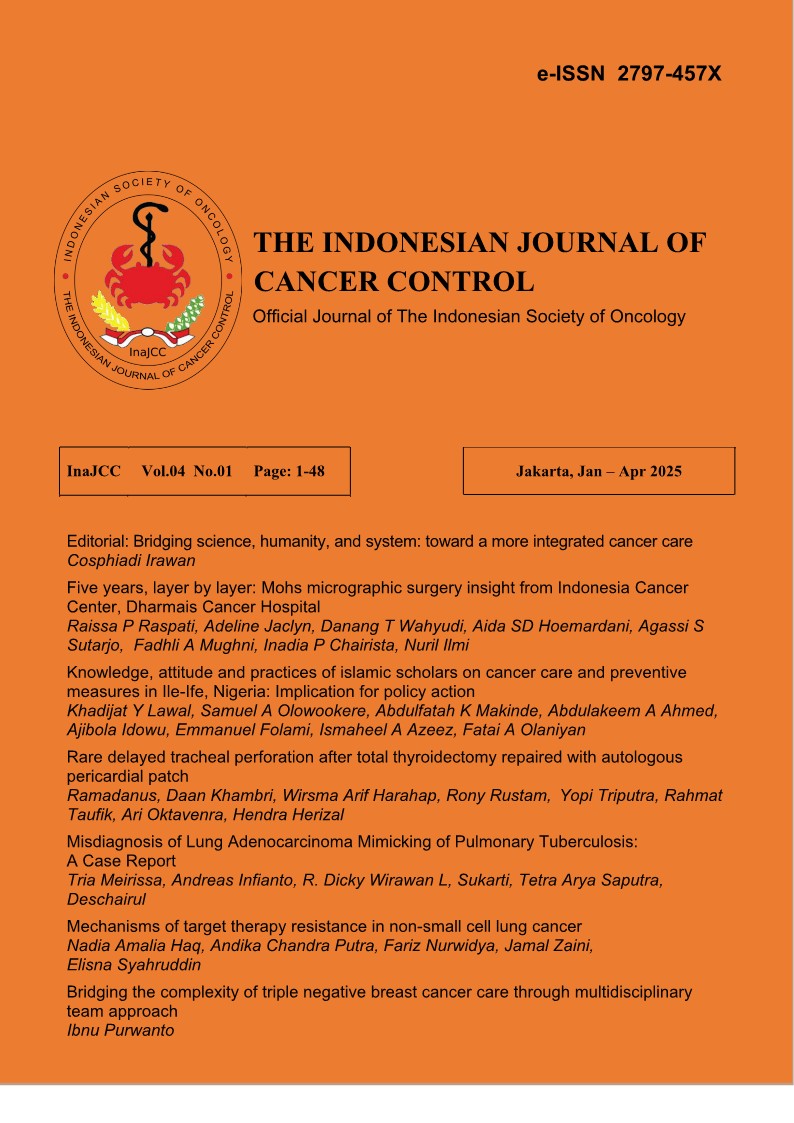
January – April
Vol. 4 No. 1 (2025)This issue traces where cancer control in Indonesia is actually won or lost: at first contact, at the surgical margin, and around the multidisciplinary table.
Two case reports document the failure modes clinicians meet most often. A 65-year-old man whose cavitary lung lesion and three months of cough were managed as pulmonary tuberculosis until biopsy returned adenocarcinoma is a reminder that, in a high-burden setting, radiological similarity is not diagnostic agreement. A delayed tracheal perforation on day four after total thyroidectomy for infiltrating bilateral thyroid cancer, closed with an autologous pericardial patch reinforced by a PTFE implant, records a complication rare enough that most surgeons will meet it without precedent.
Surgical quality is examined directly in a retrospective review of 83 Mohs micrographic surgery cases at Dharmais Cancer Hospital, where tumours in high-risk anatomical zones predominated and a margin of at least 3 mm was significantly associated with single-stage clearance. Two reviews then take up treatment failure at the molecular level, in adaptive and epigenetic resistance to targeted therapy in non-small cell lung cancer, and at the organisational level, where PD-L1 CPS, immune cell scoring and BRCA status now steer triple-negative breast cancer management and the multidisciplinary team itself becomes part of the therapeutic instrument.
A mixed-method study of 128 Islamic scholars in Ile-Ife, Nigeria closes the issue where prevention actually begins, among the people communities consult long before an oncologist is involved.
-

September – December
Vol. 3 No. 3 (2024)The issue that closes Volume 3 looks at outcomes as they are actually achieved, including outside the national referral centres.
Overall survival is reported for non-small cell lung cancer treated with systemic therapy at a regional hospital in Bandar Lampung, and two-year event-free survival is compared between germinal-centre and non-germinal-centre subtypes of diffuse large B-cell lymphoma classified by the Hans algorithm.
Two cases show how much of oncology is coordination rather than choice. A 30-year-old man presents with recurrent buccal Kimura's disease involving the contralateral parotid gland, lymph nodes and subcutaneous tissue — a benign inflammatory condition that mimics malignancy, and the first recurrent case reported in an Indonesian male. A 68-year-old man with metastatic prostate cancer is used to work through how surgery, radiation and systemic therapy are sequenced together.
A review considers the skin microbiome as both ally and antagonist in skin cancer, and a special article sets the volume against national policy: comprehensive cancer management as the route to better quality of care in Indonesia, in a country where GLOBOCAN 2020 shows a burden driven by late diagnosis and treatment delay.
-

May – August
Vol. 3 No. 2 (2024)An issue dominated by lung cancer, approached from the pathology bench, the prescription pad and the skin.
Two original studies come from Indonesian referral centres. The first reports expression of thyroid transcription factor-1, p40 and cytokeratin 5/6 in non-small cell lung carcinoma at Persahabatan Hospital — the immunohistochemical panel that separates adenocarcinoma from squamous histology when morphology alone will not. The second compares gefitinib with erlotinib as first-line treatment in EGFR-mutant advanced lung adenocarcinoma at RSP Dr. H. A. Rotinsulu, a choice guidelines still leave open.
Two case reports then follow malignancy into the skin: three Marjolin's ulcers arising in post-traumatic scars, two on the lower limb and one on the scalp, and an unusual site of cutaneous metastasis from lung adenocarcinoma, a pattern seen in roughly 3.4% of lung cancers.
The reviews close on treatment. One sets out comprehensive management of lung malignancy aimed at meaningful survival rather than response alone, in a cancer that ranks first among men in Jakarta. The other examines panduratin A as an anticancer candidate against non-small cell lung cancer, the subtype that accounts for around 85% of cases.
-

January – April
Vol. 3 No. 1 (2024)Volume 3 opens on lung cancer, and on the distance between what a tumour is and what can actually be sampled.
A cohort from H. Adam Malik General Hospital, Medan, identifies prognostic factors in lung adenocarcinoma treated with chemotherapy and EGFR tyrosine kinase inhibitors. A companion study weighs liquid biopsy against tissue biopsy for EGFR mutation analysis, in a disease where advanced patients are often too unwell to biopsy and where one piece of tissue may not represent a heterogeneous tumour.
Two studies address what happens around treatment rather than in it: recurrent nasopharyngeal carcinoma after chemoradiation, where roughly one patient in ten recurs locally into a nasopharynx left fibrotic and poorly vascularised, and omega-3 supplementation for body weight in a population where cancer-related malnutrition affects between 20% and 70% of patients.
Two reviews close on detection. One examines screening for lung cancer in women who have never smoked, a group whose mortality has been rising; the other covers frozen-section staining in Mohs micrographic surgery, the step that makes margin control possible in non-melanoma skin cancer.
-

January – April
Vol. 2 No. 1 (2022)This issue is about what treatment costs the patient, and about what can be done before treatment is needed at all.
Two original studies ask how well therapy is predicted and tolerated: tumour-infiltrating lymphocytes as a prognostic marker in HER2-positive breast cancer treated with trastuzumab-based adjuvant therapy, and the relationship between the number of chemotherapy cycles and ECOG performance status in non-small cell lung cancer.
Then the complications. A 32-year-old man presents with a falcotentorial meningioma of the pineal region, a tumour rare enough that most are found only once they have grown large enough to obstruct the ventricles and aqueduct. Perianal infection after induction and consolidation chemotherapy for acute leukaemia is traced from mucosal damage to abscess, fistula and life-threatening sepsis. Palliative management is set out for advanced head and neck cancer, for the patients who cannot undergo curative therapy in a system that has focused on cure.
The issue closes furthest upstream, with a see-and-treat cervical cancer strategy built on VIA and DoVIA screening with immediate treatment — in the cancer that remains the second most common among Indonesian women.
-
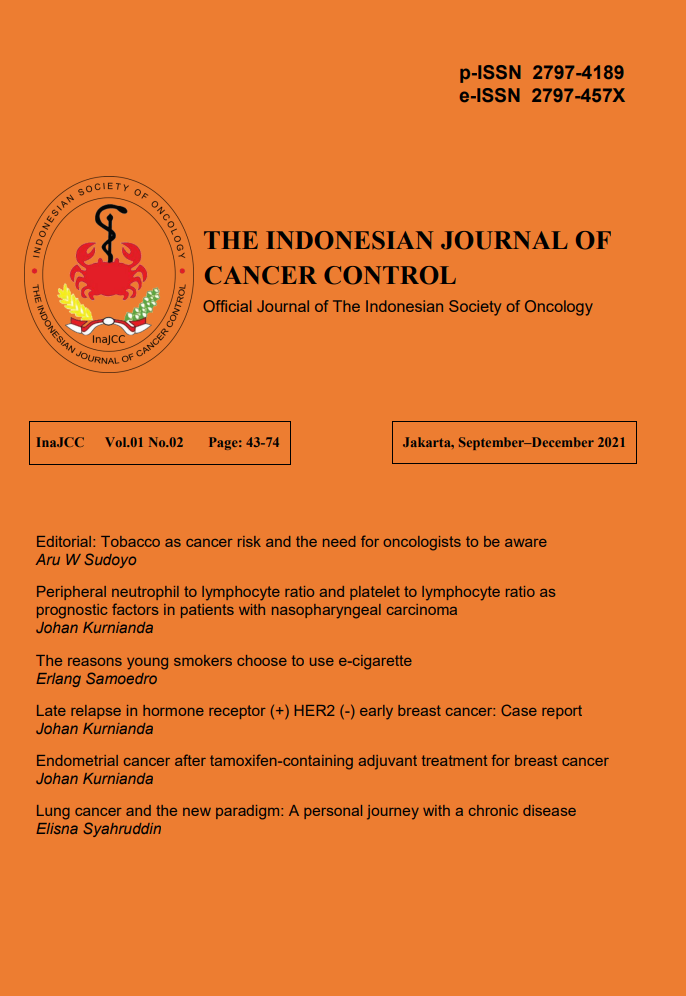
September – December
Vol. 1 No. 2 (2021)The second issue follows two threads: that cheap, routinely collected numbers often carry prognostic weight, and that cancer increasingly has to be managed as a chronic disease.
A cohort of 450 nasopharyngeal carcinoma patients at Dr. Sardjito Hospital, Yogyakarta, is used to test whether the peripheral neutrophil-to-lymphocyte and platelet-to-lymphocyte ratios — two numbers already sitting on every full blood count — carry survival information. A second study turns upstream, asking why young smokers take up electronic cigarettes, and how an industry that markets them as the alternative to smoking shapes that decision.
Two case reports trace the long shadow of adjuvant endocrine therapy: a late relapse in hormone-receptor-positive, HER2-negative early breast cancer, and an endometrial cancer arising after tamoxifen-containing adjuvant treatment. A closing review reads lung cancer — Indonesia's third most common cancer after breast and cervical — through the paradigm of chronic disease rather than terminal illness.
-
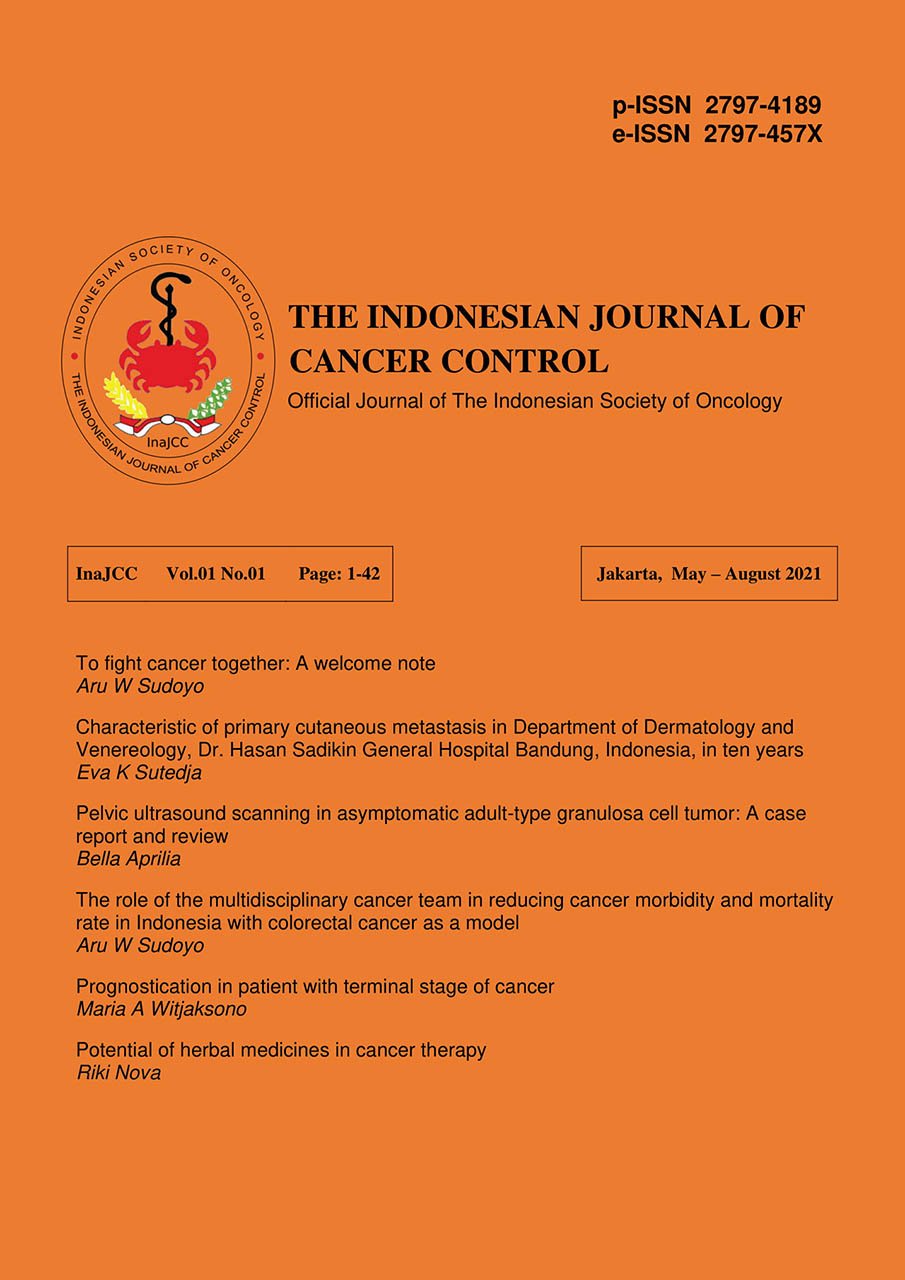
May – August
Vol. 1 No. 1 (2021)The founding issue sets out the problem the journal exists to address: cancer in Indonesia is met by clinicians who each see only part of it.
A retrospective review from the Tumour and Dermatologic Surgery Division at Dr. Hasan Sadikin General Hospital, Bandung, characterises cutaneous metastasis from internal malignancy, where breast cancer is the most common primary — a reminder that the skin is often where an unsuspected internal tumour first declares itself. A case report follows an asymptomatic adult-type granulosa cell tumour found in an elderly woman during routine pelvic ultrasound, in a disease whose five-year survival is around 45% overall but rises above 90% when treatment starts early.
Three reviews widen the frame. The first argues for the multidisciplinary cancer team as the practical answer to Indonesia's colorectal cancer burden, where more than a third of patients already have stage IV disease when they first see a doctor. The second treats prognostication as a clinical skill in its own right, the one that decides whether a patient is offered futile treatment or timely palliative care. The third weighs the pharmacological case for herbal medicines, and the difficulty of isolating a single compound selective enough to be a drug.